News
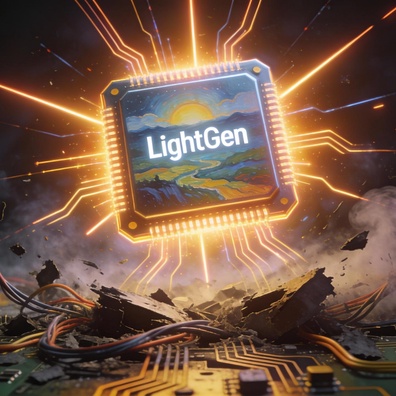
Shanghai Jiao Tong University Unveils LightGen: A Revolutionary All-Optical AI Chip for Generative Tasks
The relentless growth of artificial intelligence, particularly in generative models, has created a voracious appetite for computational power and energy. Traditional electronic chips are struggling to keep pace, creating a critical bottleneck for future AI advancements. In a landmark development, researchers from Shanghai Jiao Tong University have unveiled a potential solution: LightGen, the world's first all-optical chip designed to run complex, large-scale generative AI models directly with light, promising unprecedented leaps in speed and efficiency.A Paradigm Shift in Computing ArchitectureThe core innovation of LightGen lies in its fundamental departure from conventional electronic or hybrid photonic-electronic systems. While light-based computing has long been touted for its potential due to light's inherent speed and parallel processing capabilities, previous implementations were limited. They were either confined to simple classification tasks or relied on inefficient conversions between optical and electronic signals, which negated the speed advantages. The team, led by Assistant Professor Chen Yitong, tackled three major, long-standing challenges simultaneously to create a fully end-to-end optical system. This means the chip can take an input, process the semantic information, manipulate it, and generate entirely new media—all using light waves without intermediary electronic computation.Breaking Through the Technical BarriersThe research, published as a highlight paper in the prestigious journal Science on December 19, details the trio of breakthroughs integrated into LightGen. The first is the integration of over a million optical neurons on a single chip, a scale necessary for handling complex generative models. The second is the development of a method for "all-optical dimension conversion," which allows the optical network to manipulate data structures in ways essential for generation tasks. Perhaps most crucially, the team devised a "ground-truth-free" training algorithm specifically for optical fields. This algorithm allows the chip's optical components to be trained for generative tasks without relying on pre-existing digital datasets as a strict reference, a key step toward autonomous optical intelligence.Key Specifications and Performance of LightGen ChipArchitecture: All-optical (photonic), end-to-end processing.Scale: Integrates over 1,000,000 optical neurons.Key Innovations: 1) Million-scale optical neuron integration, 2) All-optical dimension conversion, 3) Ground-truth-free optical training algorithm.Demonstrated Tasks: High-resolution image generation (≥512x512), 3D NeRF generation, HD video generation, semantic editing, denoising, feature transfer.Performance vs. State-of-the-Art Digital Chips:With current I/O devices: ~100x (2 orders of magnitude) improvement in speed and energy efficiency.Theoretical peak (without I/O bottleneck): ~10,000,000x (7 orders of magnitude) faster, ~100,000,000x (8 orders of magnitude) more energy efficient.Publication: Published in Science on December 19, 2025.Development Team: Shanghai Jiao Tong University, led by Assistant Professor Chen Yitong.Demonstrating Practical Generative PowerThe capabilities of the LightGen chip were not merely theoretical. The research team validated its performance across a demanding suite of modern AI tasks. The chip successfully generated high-resolution images (512x512 pixels and above), constructed 3D scenes using neural radiance field (NeRF) techniques, produced high-definition video, and performed advanced operations like semantic editing, noise reduction, and feature transfer. These demonstrations prove that the chip can handle the intricate, multi-step processes required by state-of-the-art generative models like Stable Diffusion, entirely within the optical domain.Quantifying the Performance LeapThe performance metrics reported are staggering, highlighting the transformative potential of the technology. In practical tests using current input/output devices, LightGen achieved a performance that was two orders of magnitude (100x) faster and more energy-efficient than leading digital chips while matching their output quality. The researchers note that this measurement is conservative, limited by the speed of peripheral electronic equipment. In a scenario where optical input signals are not a bottleneck, the chip's theoretical performance skyrockets. LightGen could potentially offer a computational speed increase of seven orders of magnitude (10 million times) and an energy efficiency improvement of eight orders of magnitude (100 million times) compared to today's best electronic hardware.Implications for the Future of AI and ComputingThe successful demonstration of LightGen is more than a laboratory achievement; it is a significant milestone pointing toward a new trajectory for computing hardware. As AI models continue to grow in size and complexity, the energy and infrastructure costs of running them on traditional chips become increasingly unsustainable. LightGen provides a compelling vision of a future where high-fidelity AI generation can be performed with minimal latency and power consumption. This breakthrough not only opens a new research pathway for high-speed, energy-efficient intelligent computing but also significantly enhances the practical feasibility and deployment efficiency of advanced AI applications, from creative tools to scientific simulation and real-time media processing.
Perkakasan AI
3 hours ago
Google Delays Gemini's Full Android Takeover, Pushing Assistant Replacement to 2026
Android
4 hours ago

Lenovo's Legion Pro Rollable Leaks: A 16-Inch Gaming Laptop That Expands to 24 Inches
Komputer Riba
5 hours ago

Samsung Galaxy S26: February 2026 Launch, Key Upgrades, and the Rumors vs. Expectations
Telefon
7 hours ago

Meta Pauses Horizon OS Expansion, Halting Third-Party VR Headset Plans
Peranti Boleh Pakai
7 hours ago

Samsung Galaxy Z Fold 8 Camera Leak: 50MP Ultrawide and 12MP Telephoto Upgrades Incoming
Telefon
11 hours ago

Foldable iPhone Leaks Reveal Hefty Design, Sparking Debate on Apple's Late Entry
Telefon
11 hours ago

Starlink Satellite Suffers Internal Explosion, Highlighting Growing Risks in Crowded Orbit
Teknologi Satelit
12 hours ago

Xiaomi 17 Ultra Launches Early with Price Hike, Promises Major Camera Leap
Telefon
13 hours ago

Valve Discontinues Entry-Level Steam Deck LCD, Ending $399 Handheld Era
Komputer Riba
14 hours ago

iPhone Fold Design Leaks Reveal Unusual Shape, But Production and Technical Hurdles Loom
Telefon
15 hours ago

Samsung Galaxy Z Fold 8 Leak Points to Major Ultrawide and Telephoto Camera Upgrades
Telefon
15 hours ago

Honor Win Series Leaks Reveal 10,000mAh Battery, Snapdragon 8 Elite, and Surprising RT Model
Telefon
15 hours ago

Apple's Foldable iPhone Leaks Reveal Unorthodox Design and Crease-Free Ambition
Telefon
17 hours ago

Samsung's Galaxy Z Flip 8 May Skip Snapdragon, Betting Big on In-House Exynos 2600 Power
Telefon
20 hours ago
Valorant's Vanguard Anti-Cheat Now Mandates Critical Motherboard BIOS Updates
22 hours ago

Redmi Note 15 5G Clears Malaysian Certification, Global Review Highlights Key Upgrades Over 4G Model
Telefon
Yesterday

Apple ID Permanently Banned After Redeeming Tampered Gift Card, 25-Year Account Locked
Telefon
Yesterday

The "Gigabit" Gap: Why Your 1000Mbps Broadband Still Feels Slow
Peranti Rangkaian
Yesterday

Google Delays Assistant Sunset, Pushes Gemini Transition to 2026
AI
Yesterday